
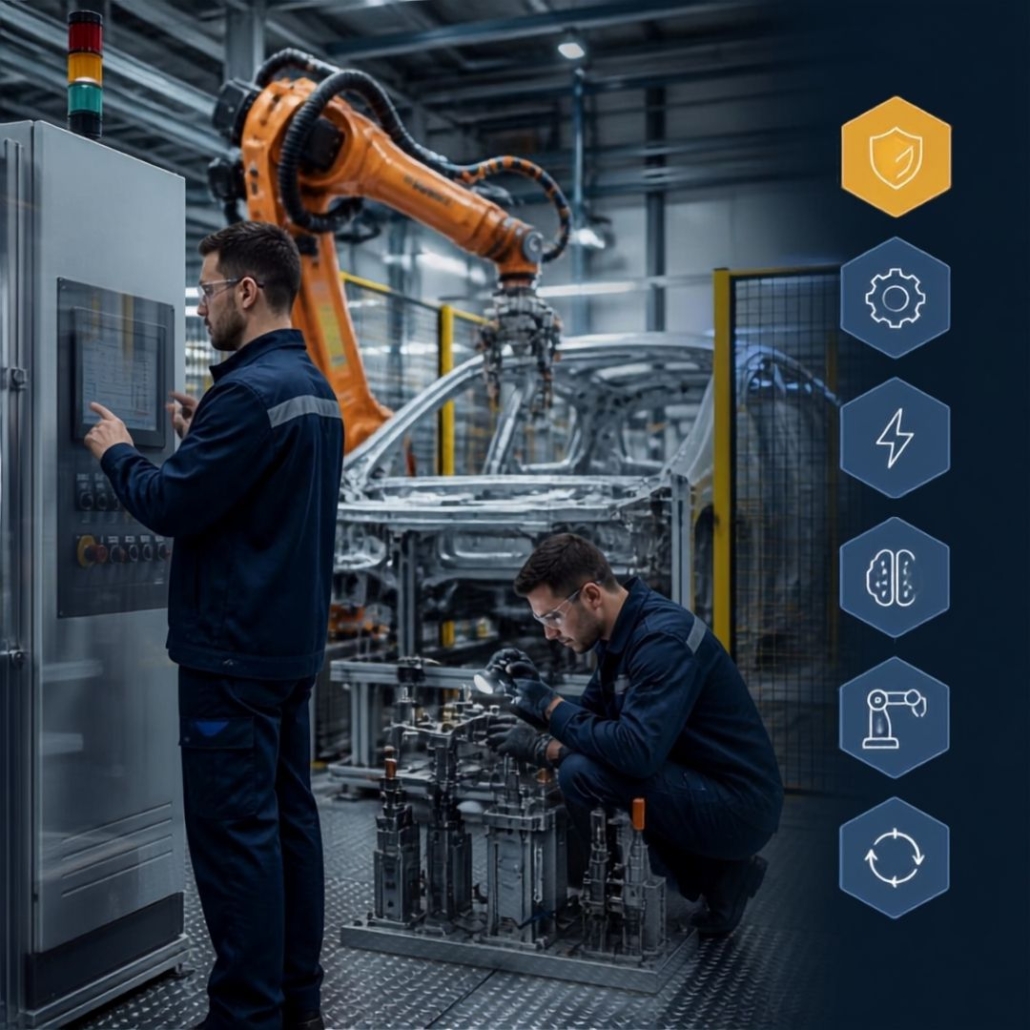
Robotic Cell Recovery in Automotive Manufacturing: A Structured Approach to Diagnosing Downtime
When an automotive robotic cell stops, the visible alarm is not always the root cause. A robot fault may originate in a fixture, sensor, safety circuit, communication network, material condition, or upstream PLC sequence. Effective automotive robotic cell downtime troubleshooting requires a structured approach that prevents teams from changing multiple variables without understanding the original event.
Begin With the Production Condition
Before resetting equipment, technicians should establish what the cell was doing at the moment of failure. Which part was present? Which step of the cycle was active? Did the fault occur after a tooling change, maintenance task, new program, or material interruption? This context often narrows the investigation faster than the alarm text alone.
Review the Cell by Technical Layer
- Safety: Guards, interlocks, light curtains, emergency stops, safe zones, and reset conditions
- Mechanical: Fixtures, clamps, grippers, alignment, obstructions, wear, lubrication, and part position
- Electrical: Power supplies, sensors, cables, connectors, I/O, drives, and protection devices
- PLC and communications: Sequence status, permissives, handshakes, network health, and fault history
- Robot system: Position, payload, collision detection, mastering, program state, and controller alarms
- Process: Welding, fastening, dispensing, handling, or inspection parameters specific to the cell
Avoid the Reset-and-Repeat Cycle
Repeatedly resetting a cell without capturing the condition can erase useful evidence and allow an intermittent issue to return. A successful restart is not the same as a completed diagnosis. Teams should document the fault state, review recent alarm history, identify the failed condition, and confirm why the corrective action restored operation.
PLC and Robot Specialists Need the Physical Context
Controls professionals can interpret logic and program states, but they also need information from operators and mechanical technicians. A missing PLC permissive may be caused by a physically misaligned sensor. A robot position fault may result from a loose fixture or inconsistent part presentation. Cross-disciplinary communication is essential because robotic cells combine digital logic with physical motion.
Turn Recurring Stops Into Improvement Work
Downtime records should distinguish symptom, root cause, corrective action, and recurrence. This allows maintenance teams to identify whether the long-term solution is component replacement, program correction, fixture modification, inspection frequency, operator training, or redesign.

Dejar un comentario
¿Quieres unirte a la conversación?Siéntete libre de contribuir!