
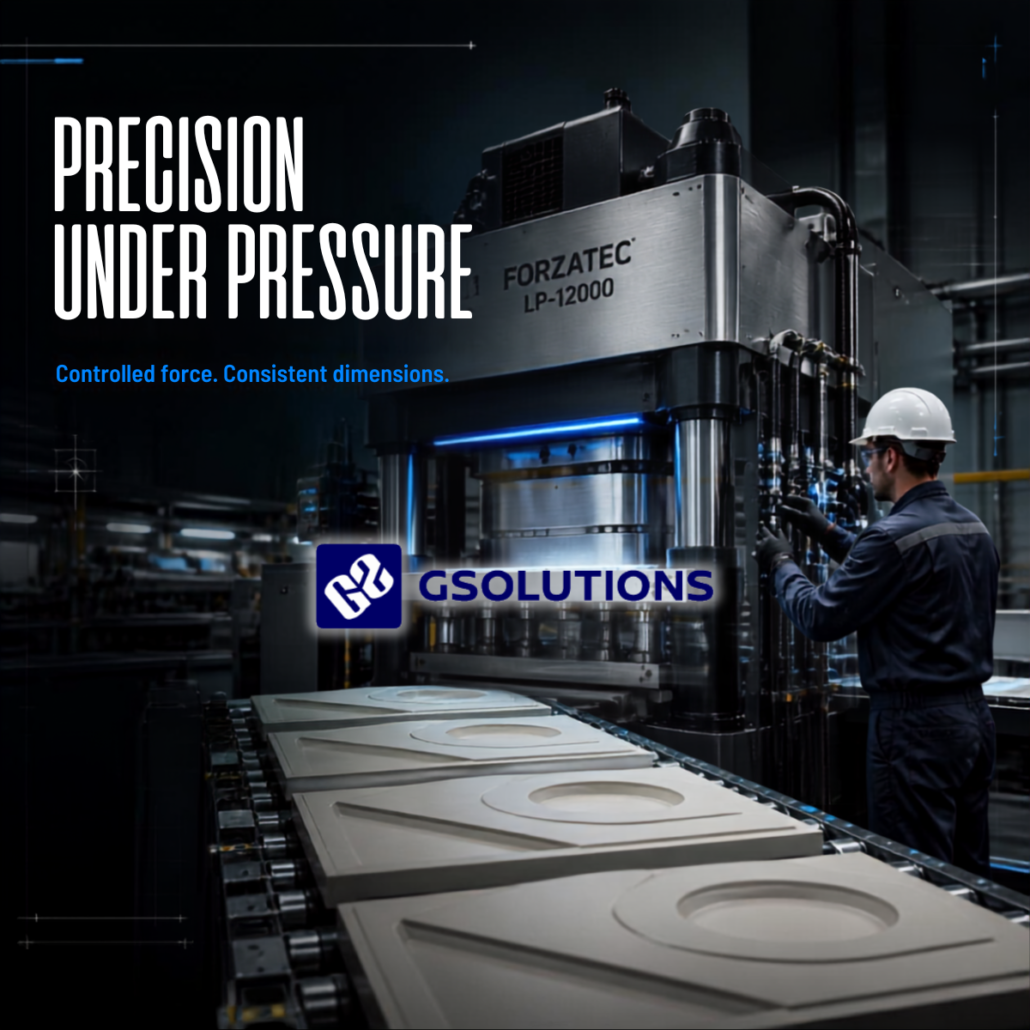
Press Operation in Ceramic Manufacturing: How Maintenance Supports Dimensional Consistency
Pressing transforms prepared ceramic material into a controlled shape with specific density, thickness, and dimensions. The process occurs quickly, but its quality depends on the condition and coordination of hydraulic, mechanical, electrical, and control systems. Ceramic press maintenance therefore affects much more than equipment uptime. It influences the repeatability of every piece leaving the press.
What Stable Press Operation Requires
- Consistent hydraulic performance: Pumps, valves, seals, filters, hoses, and pressure-control components must deliver repeatable force.
- Mechanical alignment: Guides, frames, molds, punches, and feeding mechanisms must remain correctly positioned.
- Reliable electrical operation: Motors, sensors, relays, safety circuits, and panels support every production cycle.
- Accurate control logic: PLC sequences, pressure values, timing, and alarm conditions must match the intended process.
- Controlled material feeding: Uneven distribution can create density differences even when the press itself is functioning correctly.
Why Repeatability Matters More Than a Single Good Cycle
A press may complete individual cycles without an obvious fault while gradually producing greater variation. Pressure drift, timing changes, worn tooling, contamination in hydraulic components, or sensor inconsistency can affect density and geometry. Those differences may create cracks, firing deformation, edge problems, or dimensional rejection later in the process.
Maintenance teams should therefore evaluate trends, not just breakdowns. Changes in cycle time, pressure recovery, temperature, vibration, leakage, alarm frequency, and product measurements can reveal deterioration before a complete stop occurs.
The Importance of Coordinating Maintenance and Quality
Quality data can help locate technical issues. A repeated dimensional pattern, for example, may indicate tooling wear, alignment, material distribution, or a control-sequence problem. When maintenance and quality teams review these patterns together, troubleshooting becomes more focused and less dependent on trial and error.
Planned Work Protects Tooling and Production
Press repairs performed only after failure can damage molds, extend downtime, and disrupt downstream processes. Planned inspection and replacement of wear components provide greater control over timing and spare parts. They also reduce the risk that minor deterioration becomes a larger mechanical event.

